They say the fastest way to end a relationship is to teach your partner how to drive—or how to snowboard.
The common advice is: “Just pay for the instructor. It saves your marriage.”
But we wanted to do this differently. Part of the dream was sharing the entire journey, from the first strap-in to the first black run. Plus saving €50/hour on lessons meant we could put that money toward new gear.
So, we made a deal: We would try to do this ourselves. No pro instructor. Just me, her, and a few YouTube videos.
Here is exactly how we did it—the rules we followed, the gear we changed, and the 7-day progression caught on video. How she went from “never stood on a board” to riding steep reds in just 7 sessions and why my most controversial piece of advice might have been the key.
The 3 “Golden Rules” (That Actually Worked)
We didn’t focus on complex mechanics. I just gave her three simple cues to focus on. These I think were the reason she progressed so fast.
1. The Controversial Rule: “Do Not Fall”
Most beginners are told, “If you think you’re gonna crash, just drop to your butt.” I told her the opposite: “Fight to stay on your feet.”
Why? Because if you program your brain that falling is the “safe” way to exit a scary situation, you will drop to the ground the second you feel a wobble. You stop fighting for balance.
I wanted her to build the instinct to save the run. If you catch an edge or wobble, fight it. Wiggle, wave your arms, do whatever it takes to stay vertical.
To my surprise, she took this literally. Whenever she got into a sketchy situation, instead of panicking and sitting down, she fought like hell to stay up. It accelerated her balance progression massively.
2. The Posture Hack: “Stand Up, Don’t Lean”
This was the biggest breakthrough for her turning. Beginners usually try to turn by leaning their upper body over the edge (breaking at the waist). This throws you off balance. She said the one thing that changed everything was this cue: “Knees bent, back straight.”
She stopped trying to “force” the edge and just stood tall and stacked over the board. Suddenly, the board started doing the work for her.
3. The Surfer Rule: “Don’t Look At The Board”
In surfing and probably at almost any board sport the rule there is absolute: You go where you look. If you look at your board, you will hit the ground/water. I constantly reminded her to look where she wants to go. It keeps your shoulders open and stops you from over-analyzing your feet.
Day 1-2: The Lift Hack & Accidental 360s
We didn’t start on the big slopes. We started on the flat.
Step 1: The Wiggle. The first instruction was the simplest: “Just strap in and stand there.” It feels incredibly unnatural to have your feet locked together. I had her wiggle around, lean forward and back, and just understand that the board is an extension of her feet.
Step 2: The “One-Foot” Glider. Before we even looked at the hill, we practiced gliding with the back foot unstrapped. This is the part most beginners hate, but it is the most critical skill because if you can’t glide, you can’t get on the lift.
The Lift Victory (The T-Bar Test). Our local resort doesn’t have luxury chairlifts; we have the drag lifts (T-bars/platters) that you put between your legs. These are notoriously difficult for snowboarders. I’ve seen grown men dragged up the hill on their stomachs here.
To my amazement, she didn’t fall a single time. Because we spent time getting comfortable gliding with one foot on the flat, she was stable. By the third session, she wasn’t just surviving the lift; she was relaxed enough to let go of the handle and just ride the bar comfortably. That is a massive confidence booster.
And on the slope the goal was simple: Speed control. No turning yet. Just sliding on the heel edge without catching the front edge.
Notice in the video: She isn’t looking at her feet (mostly), and when she gets wobbly, she fights to stay up instead of sitting down.
- Heel Side: Came naturally. She could slide down safely.
- Toe Side: This was the mental block. Turning your back to the mountain is terrifying.
Day 3: The Breakthrough (First Turns)
This was the “Click” moment. We focused heavily on the “Knees bent, back straight” rule here. You can see her transitioning from heel to toe. She isn’t leaning her shoulders into the snow; she is letting the board turn under her.
The day 3 I noticed she started doing something weird but impressive. She would catch an edge, spin around, do a full 360, or end up riding switch. She wasn’t doing it on purpose, but it showed me she wasn’t afraid to let the board move. We were on the right path.
Day 4: The Meltdown (And The Gear Curse)
Progression isn’t a straight line. Just when I thought she was ready, we hit a wall.
We went to a different local resort. It had only one track, but it was steep, full of bumps, and intimidating.
The Fear Factor. The terrain was too much too soon. The relief of the slope was unpredictable, and for a beginner, unpredictability equals fear. She felt unsafe. She froze up. It was one of those moments where she wanted to quit—not just for the day, but maybe for good.
My advice in that moment changed. I stopped trying to “teach.” “Just ride,” I told her. “Don’t try to learn anything new. Don’t try to perfect your turns. Just put in the hours and survive.”
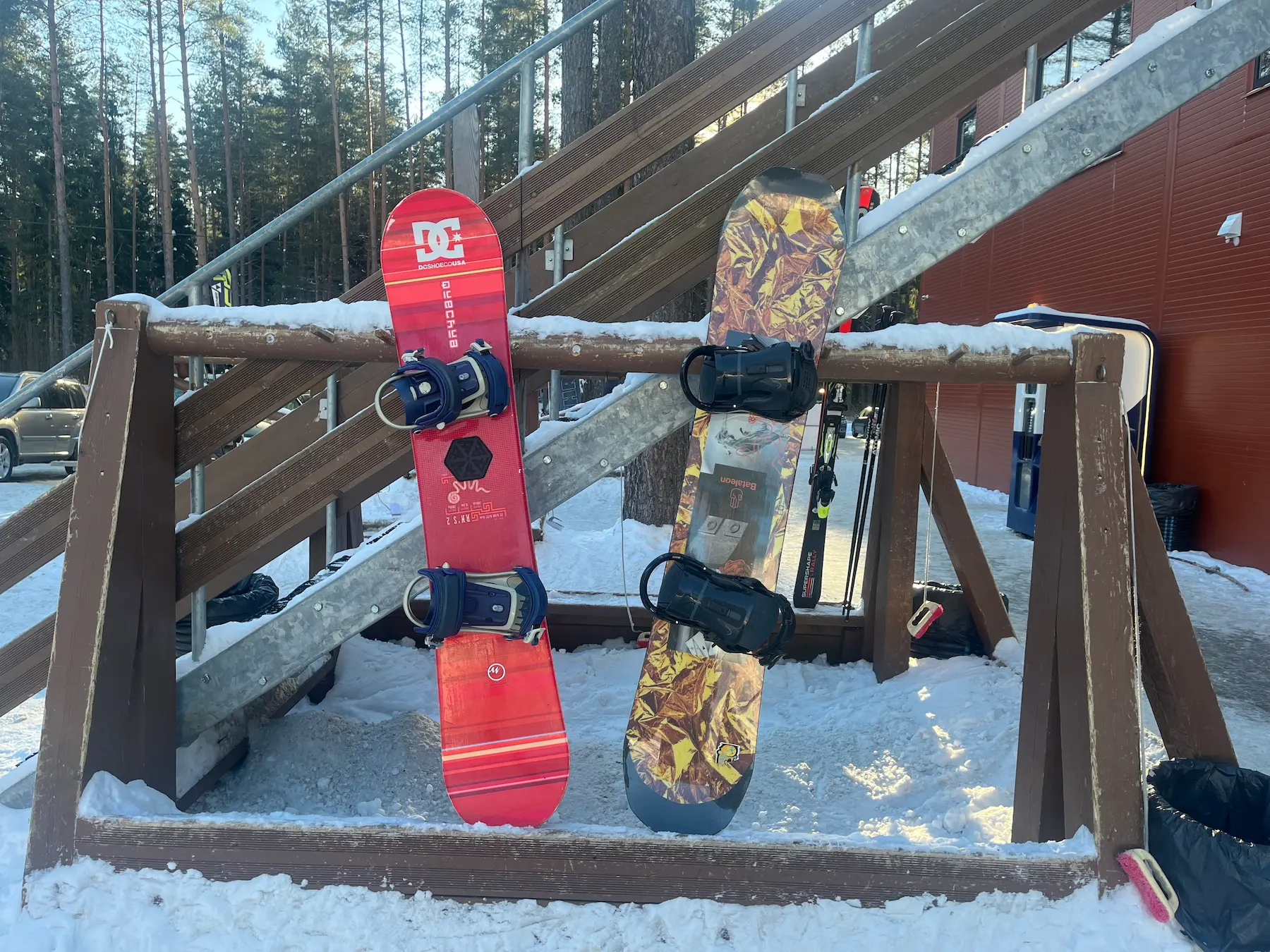
The Gear Plot Twist. As if the day wasn’t bad enough, when we got back to the car, we realized my “bargain” gear had failed us. We were packing up when I noticed the top sheet of the Salomon board I had bought for €150 had completely delaminated. The glue had dried out, and the board was literally falling apart. I will post the the full story of that gear disaster and the fix soon.
Day 5: The Flow State
By Day 5, the fear was gone. She was cruising. The new boots helped her feel secure, but the real win was her vision. She was looking far ahead, planning her line, and connecting turns effortlessly.
Day 7: The “Click” Moment
The next day we went back to our regular resort we usually go, but this time with a new plan and a different board.
Since the Salomon was dead, I dug out an old 148cm board I bought from Decathlon years ago. It was slightly shorter (2cm difference), softer, and surprisingly, that tiny change might have made the difference.
The First Run: Still shaky. The fear from the previous day was still there.
The Second Run: Something happened. She said, “Something just clicked.”
And for the first time, we rode every single track together. There were steep sections where I expected her to take the board off and walk. She didn’t. She rode them. Every successful run built a little more confidence. It wasn’t about perfect technique anymore; it was about trust. She trusted the board, and she trusted herself.
By the end of Day 7, the change was incredible. We went to the steepest run at our local hill, a solid “Red” difficulty in Alpine terms.
What to look for in this clip:
- Linking Turns: She isn’t just “Falling Leaf” sliding. She is transitioning weight from her heels to her toes to initiate a turn.
- The Toe-Side Commitment (0:08): You can see the caution. She uses her back foot to scrub speed (a classic beginner move), but she commits to the turn. She doesn’t panic and bail.
- The “Do Not Fall” Instinct (0:12): She picks up speed coming back to her heel edge. She fights for balance, stabilizes with her arms, and rides it out.
- The Celebration (0:16): That arms-up victory pose at the end is pure confidence and honestly give me chills when I look back at it.
Bonus: Day 8 (Confirmation)
We went back the next day just to prove Day 7 wasn’t a fluke. She rode even faster. (I, however, crashed while filming at the end. Proof that the student has become the master.)
The Real Reward: From “Student” to “Riding Buddy”
For me, Day 8 wasn’t just about verifying her technique. It was about something much cooler.
We spent the entire day riding the whole resort together. We hit every slope, took the same lifts, and laughed about our lines. There was no more “Teacher” and “Student”—just two snowboarders having a blast.
Before we started this experiment, I was skeptical. I’ve seen the horror stories of couples fighting on the bunny hill and beginners stuck in the learning phase (without the fun part). I honestly thought it would take a whole season (or two) before we could actually ride together.
But in just 8 days, we bridged that gap. We went from slipping down the learner slope to exploring the whole mountain as a team. And honestly? That shared freedom is worth every single fall, every moment of frustration, and every euro we spent on gear.
If you are thinking about teaching your partner, do it. Be patient, get the right boots, and remember to have fun. It might go way better than you expect.
Should You Teach Your Partner Snowboarding?
We survived the “Relationship Test.” More importantly, we are now at a point where snowboarding is something we do together, not something I do while she waits in the car.
Was it the controversial “Do Not Fall” rule? Was it the switch to the shorter board? Or was it just putting in the hours on the unforgiving T-bar lifts?
I think it was a mix of all three. But mostly, it was her refusal to quit on Day 6 when everything felt scary.
If you are thinking of teaching your partner, be patient. Find a quiet hill. And maybe, just maybe, tell them not to fall.